Thursday

2019's In-Lieu List

Hello, readers.   I could give a lot of reasons I haven't updated in a long time - some of them are reasons we all share for not being particularly motivated right now - but I'm going to get right to it.


I read some very good stuff last year that I need to pass on, so in (temporary) lieu of full reviews, I wanted to share a list of my top reads from 2019.  Each one has a handy link to its Goodreads page instead of Amazon, since I don't presume everybody wants or has the means to make purchases right now.  I love Goodreads and I often use my to-read list to look for books I can borrow from various libraries.  Here's the list - I've noted a few things, such as format and audience if it's not adult fiction.  Please comment if you have something (spoiler-free) to add about any of the books or would like to recommend to me and the other viewers.  Here's hoping for a more productive season - stay safe and keep reading.

  1. Doctor Who: Nothing O'Clock (Doctor Who 50th Anniversary E-Shorts #11)    Neil Gaiman
  2. Harrow County Volume 1: Countless Haints    Cullen Bunn *graphic novel*
  3. Recursion    Blake Crouch
  4. The Last Time I Lied    Riley Sager
  5. Hangman    Jack Heath
  6. Just One Bite   Jack Heath *sequel to Hangman*
  7. Jacaranda (The Clockwork Century, #6)    Cherie Priest  *short, ok to read alone if you haven't read the series*
  8. This Body's Not Big Enough for Both of Us    Edgar Cantero
  9. The Cape    Jason Ciaramella  *graphic novel*
  10. The Guild Volume 1    Felicia Day  *graphic novel*
  11. Elevation    Stephen King  *short*
  12. Yesterday    Felicia Yap
  13. Nyctophobia    Christopher Fowler
  14. Ghosts of Gotham    Craig Schaefer
  15. Cold Spectrum (Harmony Black, #4)    Craig Schaefer
  16. Glass Predator (Harmony Black, #3)    Craig Schaefer
  17. Red Knight Falling (Harmony Black, #2)    Craig Schaefer
  18. Harmony Black (Harmony Black, #1)    Craig Schaefer
  19. Cari Mora    Thomas  Harris
  20. The Accident Season    Moira Fowley-Doyle  *YA lit*
  21. Small Spaces (Small Spaces, #1)    Katherine Arden  *kids lit*
  22. Invasive    Chuck Wendig
  23. Zeroes    Chuck Wendig
  24. Someone Like Me    M.R. Carey
  25. Jane Steele    Lyndsay Faye
  26. Truly Devious (Truly Devious, #1)    Maureen Johnson
  27. Alice Isn't Dead    Joseph Fink
  28. The Suicide Motor Club    Christopher Buehlman


Saturday

The Liar's Daughter by Megan Cooley Peterson


When a book starts out by describing a child having her hair bleached to appease Mommy, you know some ish is gonna get weird.

When you read about a band of children being stashed at a special 'safe place' on the grounds of an old amusement park, you start wondering how weird.

When the narrator, 17-year-old Piper starts waxing on Father's wisdom, including such gems as
- stay inside the fence because Outside is full of poison, including diabetes medication
- don't let your 'brothers' see you undressed, because men are naturally weak and get rapey
- nothing good exists that didn't happen before whatever year 101 Dalmatians came out on VHS

...then you might find yourself wanting to put down the book and back away slowly, before that level of crazy leaks onto your purple corduroy bellbottoms  normal clothing.

Piper's story is broken into Before and After (social services and cops show up to reclaim all the kids and haul off the infallible Prophet  crazypants cult leader and his wife).  Her memories start to bash against each other, she's losing chunks of time and the new home she's landed in is dangerously close to cell phone towers and kids who don't respond with "that'd be aces"  if you suggest something fun.

Not a terrible book overall, and I always appreciate creepy abandoned amusement parks, but a little lower-end of the young adult difficulty spectrum.  As far as cults go, the activities were fairly tame,  especially compared to stuff like The Sacred Lies of Minnow Bly.  If young readers are interested in fictional cults (and somehow a teen romance stuffed in there), The Liar's Daughter might be a good place to start.  If they're looking for more brainwashed meat on the bones and are somewhat trauma-resistant in their book selections, Minnow's the way to go.  Either way, they're good cautionary tales:  don't go with strangers, find help if the adults around you are doing stuff that feels wrong, and for the love of all that's good, no second-guessing the benefits of insulin.

My back yard has the best view (and the most necessary tetanus shots).


Thursday

Slasher Girls & Monster Boys, stories chosen by April Genevieve Tucholke

I almost never recommend short story collections.  It's usually because I can't justify telling someone to watch a dozen little mind-movies when half of them seem pointless or hackneyed.  I'm writing this review because I just got punched by one of the best YA collections I've found in years.  YEARS.  Good horror and good short stories make my day.  This book just slammed them together in the best way and I could not find a bad story in the bunch.  Not one.  This is not a book, it's a frigging unicorn.  A really creepy unicorn.  Maybe this one:
I'm guessing this one isn't powered by giggles and joy.

 Anyway, the YA genre has certainly come a long way and gets a lot more gruesome than it did back in my day (sorry, Mr. Pike), but it seems paranormal romance (aka "my boyfriend is hot and toothy") has gotten spread around like hybrid herpes and the horror genre itself hasn't really been properly bringing its kid sibling along.  I decided to give this one a chance because of, well, the cover alone:


 Even if YA's not your prime choice, SGMB has *chops*, with everything from shapeshifting vigilantes to mountain legends to zombie comedy and while some of it wasn't especially brand-new subjects, all of it gave me some creeps, some new authors to look for and, in places, a longing for the good old horror that swept in before torture and remakes took over. Some of the stories may be what you consider typical fare for a collection.  A Lewis Carroll-inspired story is almost par for the horror course, I think, but Carrie Ryan's "In The Forest Dark and Deep" made my skin crawl and I now desperately need to avoid teacups.   The very last story, a revenge piece called "On The I-5" by Kendare Blake, felt so clear and cold to me that I wanted to see it on a screen, to see if the diner lights and desert grave were that vivid *outside* my head. (I just received a reply from Ms. Blake saying this story is being adapted to film, so buckle up and keep an eye out.)


A feature that made my day as well was the bit of info at the end of each story, written upside down:  the film, book or song that inspired the author.  There's a bit of everything in here, from slasher movies to classic novels to a Nirvana song that I had to actually Google.  Some of the stories' inspirations are easy to spot, others not so much.

TL:DR Tucholke knows how to pick 'em and this book has a flight of tastes that kept me reading.


Monday

A Taste For Monsters by Matthew J. Kirby


London, circa 1888.  A would-be nurse disfigured by phosphorus.  A dude with a head so big he would snap his neck by lying down.  An infamous killer and the ghosts of his victims.  Welcome to Matthew Kirby's 19th century.  I was today years old when I realized this is the most aptly-named book I’ve met lately; a person with a taste for monsters of any sort, spectral or alarmingly human or just misunderstood, is the ideal reader here.

Our heroine Evelyn is homeless after losing her job in a match factory.  A match that will strike anywhere was deemed worthy of a few missing jaws, and she is gobsmacked (pun intended) with a rowdy case of phossy-jaw (phosphorus jaw).  The doctor was able to save part of her jawbone and some teeth, so she feels lucky.  The simple fact that *that* is considered lucky should tell you where this is going. Just go with me when I say the condition is horrifying and it’s unlikely she would be able to chew gum or stop scaring small children anytime soon.  I of course Googled the term and promptly lost my appetite for several hours, but if you feel the need, go for it. 

She wears a shawl draped over part of her face and wants to find somewhere to hide away so she can stop feeling like nightmare fuel.  After scraping by on the streets for some time, she’s off to London Hospital to apply for a nursing job.  With no credentials and a face that only a butterknife would love, it’s no surprise she is turned down.  What is surprising is the job she is offered – attendant to a special reclusive patient.  This is generally when people say “uhhhh, no” but the jawless can’t be chewers – I mean choosers, sorry - and Evelyn accepted.  Her patient? Joseph Merrick, also known as the Elephant Man. I presumed the matron’s idea was that they will either accept each other as equally disturbing and be cool with the arrangement, or they will feel even worse together and perhaps form a suicide pact.  Either way, he finally has someone willing to come attend to him all day and she has a hiding place.

As you might expect, Evelyn sees this dude in various states of undress and goes off her feed for a while, but eventually the two become good friends.  Just as things are getting about as normal as you can get in this situation, strange apparitions start popping up every night and scaring the living trunk off Joseph.  Given that it’s the late summer and early fall of 1888 in London, it’s not hard to put two and two together in an alley with a uterus and see Jack the Ripper’s handiwork.  But why are the ghosts throwing themselves at a shut-in who can’t even get around town? He recruits Evelyn to help put the spirits to rest.

The reason I liked this book – despite some nauseating descriptive bits – is that it does not just twirl around advising readers “look beyond physical form because scary people are cool” with nothing substantial underneath.  That’s good advice but it’s not exactly protein for a reader who loves historical fiction with ghosts and mysteries.

A note:  I confess I’m a big fan of Ripper-related fiction and I loved that he was part of the story without turning it into a gore-fest.  If you need the whole story to turn around him, give this a pass and try Mike Resnick’s Redchapel.  If you’re cool with him being a large piece of the kidney pie but not the whole pan, A Taste for Monsters should do the trick.


Saturday

The Last Thing I Told You by Emily Arsenault


Full disclosure:  I received a free copy of this book in exchange for a review.  What I wish I'd also received was a better pay-off for a story with a lot of promise.  Generally, I like novels about therapists and psychologists. The variety of patient stories, the struggle for their own stability, and the chance of great surprise when it turns out they are much scarier than anything you’d hear in their sessions.  Not everybody can be Hannibal, but there’s always that chance that the plaid suit and the kitchen utensils will come out by the tenth session. I got hooked into this particular story with the promise of a mystery and an unraveling patient-doctor relationship.

The book opens in the office of Mark Fabian, therapist for years and corpse for hours.  His head is bashed in, his patient notes are sketchy, and oh, by the way, his closest friends report him as having memory problems recently, so good luck with those notes again. The chapters alternate between narrators Henry, a local cop who gained fame from a retirement home shooting a few years previously, and Nadine, a former patient of Fabian’s.  I’m still getting my head around a shooter in a frigging *retirement home.* Not that it’s too farfetched these days, but what the what?
Betty White would have taken his punk ass out in a second.
Nadine’s story alternates between the present and 1997, when she was in therapy after a violent incident at school – with all this backstory, you expect her underlying psychosis to be something shocking.  She even writes that perversion is in her blood (cue dramatic music).  I don’t know if the author planned something bigger to explain the build-up to the outburst and then gave up or we’re actually supposed to be shocked by something that turns out to be terribly garden-variety.

Henry’s side of things covers his involvement in the shooting (he took down a shooter and is now a local hero who just wants people to stop calling him that) and his attempt to piece together how Fabian (I kept reading that as ‘Fabio’) wound up dead.  Oh, and his kids are getting warped by fairytales with iron shoes and decapitations.  I don’t know if that’s supposed to be a cautionary bit about your kids winding up in therapy or a suggestion for scary stuff hidden in children’s fiction. Either way, now I want to read ‘The Red Shoes.’

Honestly, this book felt like such a tangled mess that I can barely write this review.  It started out so readable and then just seemed to drag into wet noodles. Other crimes in the area are mentioned, but written in an almost throw-away fashion, even though they are suddenly a big deal for the ending.  There’s no startling reveal of some long-buried secret to explain Nadine’s violence.  There’s no startling reveal that Henry is someone interesting.  Fabian’s murder has one of the most beige explanations I’ve ever read.

"Yes, I know, but I'm trying to look Scottish or something."
If a book starts out crap and then ends the same way, that’s bad. This whole bait-and-switch thing seems even worse, because now you’ve had a chance to get excited over where things are going. Surely this will not end in you slapping yourself awake at nine p.m. and throwing the book into the library donation bag.  Just because I was almost asleep doesn’t mean I take the whole bait-and-switch thing lying down. I won’t be looking for anything else by this author.  Now if someone will introduce me to a nice novel involving a suit and fork…

Wednesday

Frances Hardinge's A Face Like Glass


You know you look great. Great. Painfully stunning. Then the person waiting for you looks up and their face says you are the last thing they want to see and possibly you also have half a biscuit stuck in your teeth.

It sucks to see disappointment, fear (unless you are trying to scare someone) or disgust (maybe you picked that nose on purpose, who knows) on a face, but it's still information to help us process the situation.

We need people's faces - nonverbal communication typically counting for more than half of the information exchanged in our conversations to give us clues.  Now imagine a society where everyone just has a series of learned configurations to represent everything they are feeling or thinking.  It's somewhere between this at birth:


or maybe these guys later, depending on your financial state because learning new expressions actually costs money.


   In A Face Like Glass, we meet Neverfell, a preteen orphan with a past she can't remember, who is growing up in Caverna, a sprawling underground civilisation that was created after horrible things devastated the cities on the surface.  Many generations later, the inhabitants still don't believe it is safe to leave so they party/drudge/court eyesight problems and asthma in their city below.  It's a very hierarchical scene with drudges doing all the dirty work, tradesmen making delicacies just to keep their ruler The Steward from getting bored and nobility playing mind games.

   Of course there's a statement about injustice and entitlement, but the part of the book that just kept fascinating me and creeping me right the hell out was the facial thing. Caverna infants come out "blank as eggs" and are taught a few expressions during their time in massive crèches. Lower-class babies are taught about what you'd expect for a servant (i.e., automaton who can't complain), usually amounting to only 3 or 4 expressions.  No matter if they are sick, dying, furious, joyful or what; they can only make the "I'm eager to serve" or "I understand your need to punish me" or "I'm happy that I sleep on rocks" faces. Upper-class kids are given more and can buy lessons from Facesmiths ("Face 57, the Willow Bows Before the Gale" is an actual thing) as they get older.

   The unique Neverfell has a 'face like glass,' in that it allows you to see through to whatever she is thinking or feeling. No Facesmiths required, lots of suspicions raised. Of course this makes her very special and very upsetting to the status quo.  When she gets caught up in a rich girl's scheme, Neverfell starts seeing things she can't unsee and finding out more about who she is - and why it's so important that nobody rocks The Steward's boat.

   Her story was frustrating at times but that actually worked to make it more believable. Of course someone's going to get busted half a dozen times when they have no Face 372, Dawn Breaking Over Ohio or whatever to cover up their intentions. Hardinge does a good job of building a world that is sprawling and vivid - it startled me all over again when someone's carriage was hoisted from cave to cave or people fed the lamps hanging over everything. I felt like I was right there (and then remembered I was also claustrophobic.  Maybe don't read this in a small, enclosed space.)

   Usually I refuse to recommend post-apocalyptic stories but this was so far post and the scenario was so strange that I just have to tell people to read it. Also there's no teen romance, vampires or boarding schools, so if you're inundated with all three, this is a nice break.  Hope you enjoy the book, try Hardinge's other work or, at the very least, feel relieved that all those cringeworthy selfie faces didn't have to be paid for.


Friday

Burntown: Can't see a clear story or likeable characters for all this smoke

I really wanted to like this book. I didn't even stop to read the summary, just said "ooh, the new Jennifer McMahon!" and marked it 'want to read.' Her books usually have characters I care about, plot twists I don't see coming and clear narrative. This book seems to have been written by someone else, because it has none of those things.

Narration is a jumble of viewpoints including a boy who witnessed his mother's murder, a homeless girl who lost her house and half her family in a flood, a drug-dealing closeted lesbian teen, a morbidly obese lady who pretends to be a fat lady in a circus and a private detective who features in the fat lady's mental circus as the strong man. Got all that? The jumping around was dizzying and the main character - the girl from the flood – seems as flat as the others. I thought I was misunderstanding who the protagonist was. In the end, I think nobody was. Things happened around them and to them, but none of them seemed to really push the story along.

The book begins with a young boy witnessing his mother's murder by a man in a chicken mask.

(Might be frigging terrifying but still makes me think Chik-fil-a got a little too vindictive about bad reviews.)

Murder evidence is found and the killer is caught...until the same chicken-masked man (I hate typing that) reappears several years later in pursuit of the now-grown boy's own children. What follows is the meandering story of the man’s daughter, now four years older and surviving on the streets by sticking flaming cotton balls in her mouth for money and candy.
I really wish I was making that up.
Actually, I wish nobody had made it up. Homeless people get a bad enough rep.

Did I mention there's also a device that lets you speak to the dead using a radio? That particular bit gets tossed in and you'd think that this supernatural aspect would be threaded through the storyline. NOPE. Even the character who's supposed to be dead-set on retrieving the radio's blueprints doesn't really seem to care - it's like the villains who want to take over Gotham but don't notice they need to actually kill Batman instead of hoping he doesn’t foil their plans. Ugh.

The twists were sort of lazy squiggles and for the first time reading this author’s work, I figured out the surprises before the reveals. Characters reacted in totally unrealistic ways to incredibly stressful and dangerous situations. The ending seemed simplified to the point of juvenile and rushed. Burntown was a burn-out.

Thursday

The Witches of Eastwick or How I Learned to Hate John Updike


Movies tend to screw up books.  It happens so often you can say "oh, I saw the movie" to anyone recommending a book and they will automatically go into zombie-groan-eyeball-rolling despair.  However, I saw the movie version of The Witches of Eastwick years ago (it was released back in '87) and it grew into a thing of beauty compared to the tripe from which it sprang.  It still had some scenes that made me turn green and the casting made no sense - with the exception of Jack Nicholson - but the story was far less of a clusterfoque.  *I would like to clarify that this book and movie are in no way connected to the book and tv show The Witches of East End.*


In the book, we meet three witches living in a small town and screwing everybody.  No kidding, those are the two things you are told straight off and then repeatedly about these women.  It was the late 60s and that whole sexual freedom thing was rampant. One of them even boffed the other one's husband but nobody cared. We're also told one of the husbands was transformed into a table mat, another is hanging like dried flowers in a basement and the third turned to powder and is shelved in an urn.  Somehow the women are also involved with this Unitarian church, one of them is nailing the pastor and all of them became extremely powerful sorceresses upon moving to the town, though that's never really explained.  Makes me want to stay the hell out of Rhode Island, because who wants a third nipple? Wait, did I tell you all three women had an extra nipple? yeah, there's that.

Enter a scruffy sleazeball who sets up an unseen lab in a crumbling mansion and installs a teak wood spa room with a retractable roof where he can have orgies and share his greasy loins with women who are inexplicably drawn to him.  All three witches go from scorn to hot-tubbing in a blink.  At one point, one of the witches actually kisses his ass.  There's a visual.

To sum up, we've got some longstanding criterion for your average American witch:  the presence of a third nipple (aka a "witch's teat"), inversion of religious phrases to perform pagan rituals and blind devotion to a devil character to whom she shows allegiance by kissing his backside.  We've got what I'd call serious misogyny with a dash of "look how well I know witchy shit" e.g,  "I made it rain so I could walk my dog on the beach! Watch out for piles!"  What we don't have are characters that make you care about how they turn out, explanations for their sudden mastery of the craft and roles for any strong women who aren't just relying on smooching devil tupkes.  If you think Mad Men just wasn't tough enough on those crybaby girls who shouldn't be in an office anyway, this book might be for you.  For the rest of us, there are plenty of others that won't give you the urge to vacuum in high heels...for example, Alice Hoffman's The Probable Future, those East End chicks I mentioned, Jim Butcher's Dresden Files, or Erik Setiawan's Of Bees and Mist.

Saturday

Last Words


"Don't embarrass me with this shit."

Investigator Mark Novak can't get those words out of his head; two years ago they were the last words he spoke to his wife before she was murdered.  It also happens to be exactly what I was thinking when I started this book.  I like Koryta but he's been hit ( So Cold the River ) or miss (Those Who Wish Me Dead) in the past.

Mark works for a pro bono company that frees wrongfully convicted criminals.  They get a letter from a small-town pariah named Ridley Barnes who isn't even in prison but for years has been under suspicion for murder.  When a girl went missing in the local caves, Ridley was the experienced (if mostly batshit, no pun intended) cave expert who brought her out.  Bad news was, she was dead and his time in the cave was riddled with memory holes and strange exclamations about the mystical qualities of the cave.  Didn't help he referred to the cave as a "she."  Anyway, the town decides he's guilty despite lack of evidence and Ridley decides he has to find out for himself if he is guilty.  Enter Novak, who has been careening around looking for whoever killed his wife.

Ridley's hometown of Garrison, IL has all the stereotypical small-town characters you'd expect and sadly, none of the surprises.  Again and again, Mark runs into people who won't talk, truth that's skirted like an antebellum housewife and characters that lack so much fleshing-out they may as well be on a forensics table.

I admit caves scare me silly, so if I'm going to spend even imaginary-time in one, there had better be a pay-off.  I waited and hoped that there would be something supernatural or at least surprising as the mystery unfolded, but only got a goose egg and a reveal that was lacking in both imagination and impact.  If you're interested in caving - or even not - and want an interesting story of what goes on down there,  let me recommend Jeff Long's The Descent (not the same story as the movie, trust me) or Cherie Priest's Those Who Went Remain There Still.

11/22/63


Every time I try to write this damn review, it just goes haywire.  I don't want to prattle and wind.  I want you to know this book is the best thing King's written since the denoument of The Dark Tower in '04.  I want you to know I walked around feeling like someone directly tapped into my head and found what I didn't realize I wanted so badly:  a chance to see what things were like long before I ever got here, to see my grandmother dance or our town before it was filled with crappy antique shops.  I want so much to visit a time when the internet wasn't being used as a replacement for the library and phones were used as *phones* and not gadgets to avoid actually connecting with people.  I think a lot of other folks would feel the same way (though I may be younger than many of them).  I don't think I'd take on the task of preventing assassinations, but then, I like to keep things simple and avoid bulletholes.

Wednesday

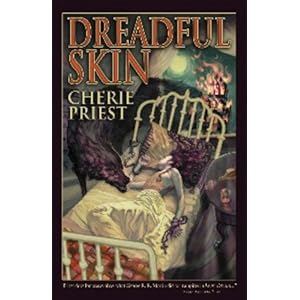
Dreadful Skin

I love books that take a real-life mysterious event and give it a much cooler explanation.  Cherie Priest pulls that off

Thursday

Cherie Priest's Fathom

As you can see from my other reviews, Cherie Priest is firmly planted at the top of my Authors Y'all Should Be Reading Already list.  If you're not much for steampunk or psychics, try Fathom, which is about

Faerie Tale by Raymond Feist

This book was recommended me to quite a while ago and the cover looked neat, so I broke ranks with my pre-designated Jane Yolen  and went for it.

Seriously, not judging a book by its cover is hard to do when there's not only a creepy hole in the barn wall view but also... a big spidery thing drooling over

Friday

John Dies @ The End - the title with the cool "at" sign - by David Wong

Thank you to my friend Jolie for mentioning this book with the cryptic warning "weeeiirrrrd stuff, that one."  That got me motoring to the library and I've never regretted it.  I haven't read anything this funny since my serendipitous meeting with Christopher Moore's You Suck: A Love Story a few years ago.

Tuesday

One Mississippi

I've been - for whatever reason - denying myself  Mark Childress's book One Mississippi and it was like falling out of yogurt into Dairy Queen Chocolate Cherry Cheesequake Blizzards.  I don't even care how my thighs look.

Saturday

Mapping Cherie Priest's Chattanooga: the Eden Moore trilogy

After reading Cherie's most recent work, Boneshaker, I was completely caught up in the north Pacific coast.

So I picked up her first book about Eden Moore and was completely blindsided that it was set in Chattanooga, Tennessee.  (Ha, I hear my friend Joe groaning.)

Tuesday

Project 17

Old-schoolers like me may recognize the author Joan Lowery Nixon, who wrote YA back in the day (80's, for all you youngsters). One of the few books I read as a kid that scared me mindless

Wednesday

Boneshaker

I have long resisted reading steampunk.  Possibly because I'm not very mechanically-minded and all the cogs and steam made me nervous. Maybe because I have a fear of goggles and seeing the extra layers and straps in the costumes made me feel fat.

Tuesday

The Mad Cook of Pymatuning (which, sadly, cannot be eaten with a tuning fork)

Picture it: a New England summer camp in 1952.  (Give yourself a high-five if you thought "...Sicily" instead!)

Toss in a bunch of white boys who are 99% completely uninterested in bonking the one chick who is not on the staff but somehow allowed in the camp.  Next, add a Token black guy who pops up with the exact history book needed to identify weird crap that is going on with the camp's new 'guide', a kooky Indian touting the bad mix of loinclothery and sadism.  Frankly, the fact he was like 50 years old and perfectly ok

Sunday

Jack and Ma: reviewing Room

Emma Donoghue's new book, Room, is full of wonderfully unique surroundings such as Wardrobe, Bed, Rug, Plant and Bathtub.  For five-year-old Jack, there is no more than one of anything, so articles got tossed out (imaginary)Window.